Calculemus
“Let us calculate,” said Leibniz. Twenty-five texts, from Hephaestus' self-moving tripods to Rossum's robots, put the machine together on paper long before anyone built it. Keep the workshop, and decide what to do with the questions.
Calculemus is a solitaire game about the prehistory of artificial intelligence. You do not play a philosopher; you keep the workshop of calculating reason itself, station by station, from Homer and Aristotle through Llull's combinatorial wheels, Hobbes' “reason is nothing but reckoning”, Leibniz's calculus, Boole's laws of thought, Lovelace's Note G and Jevons' logic piano, to Čapek's play of 1920. The game ends at the threshold, just before 1936.
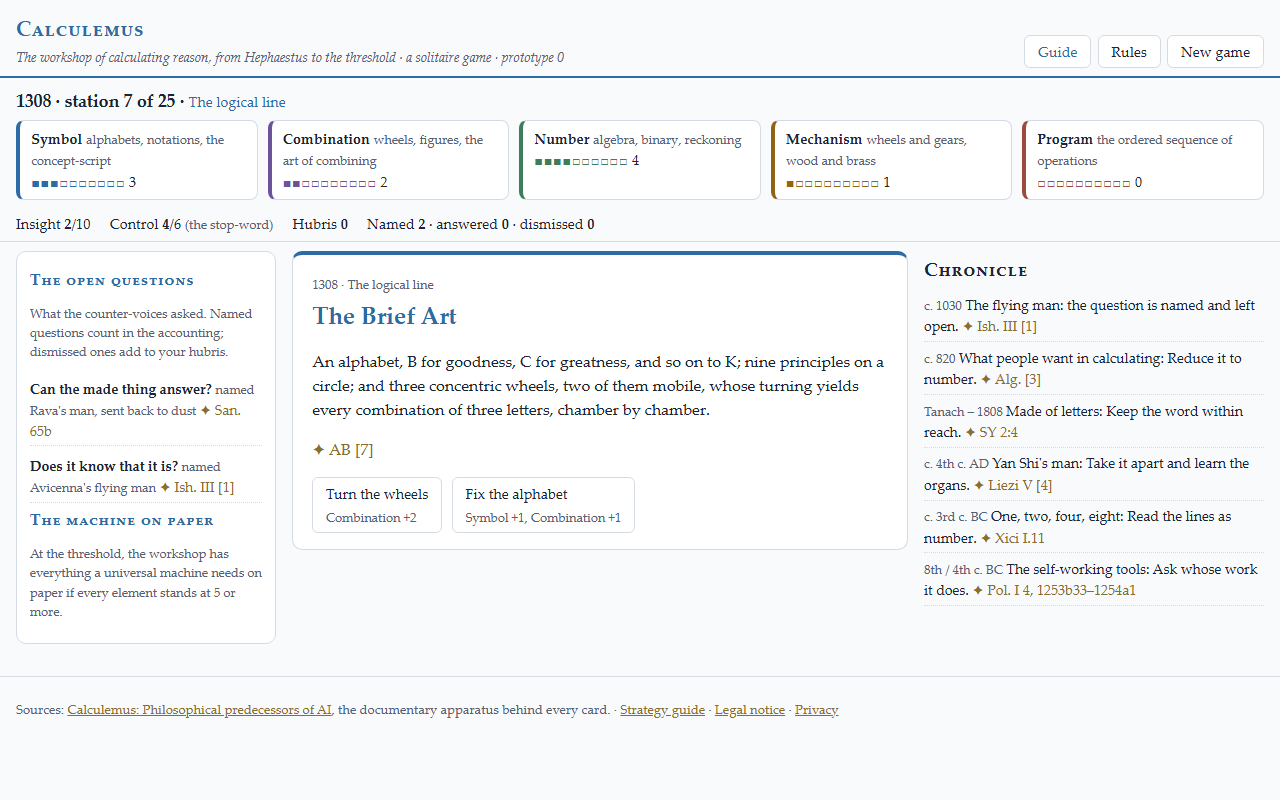
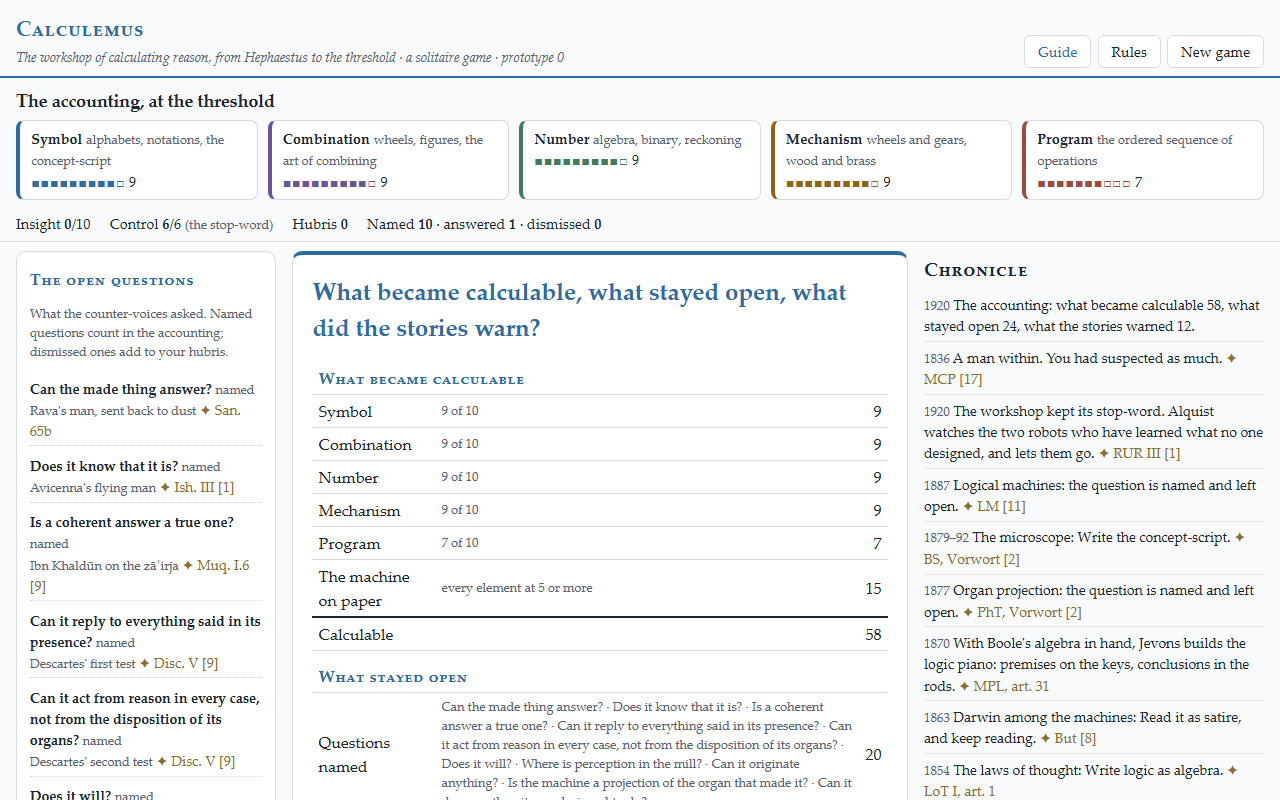
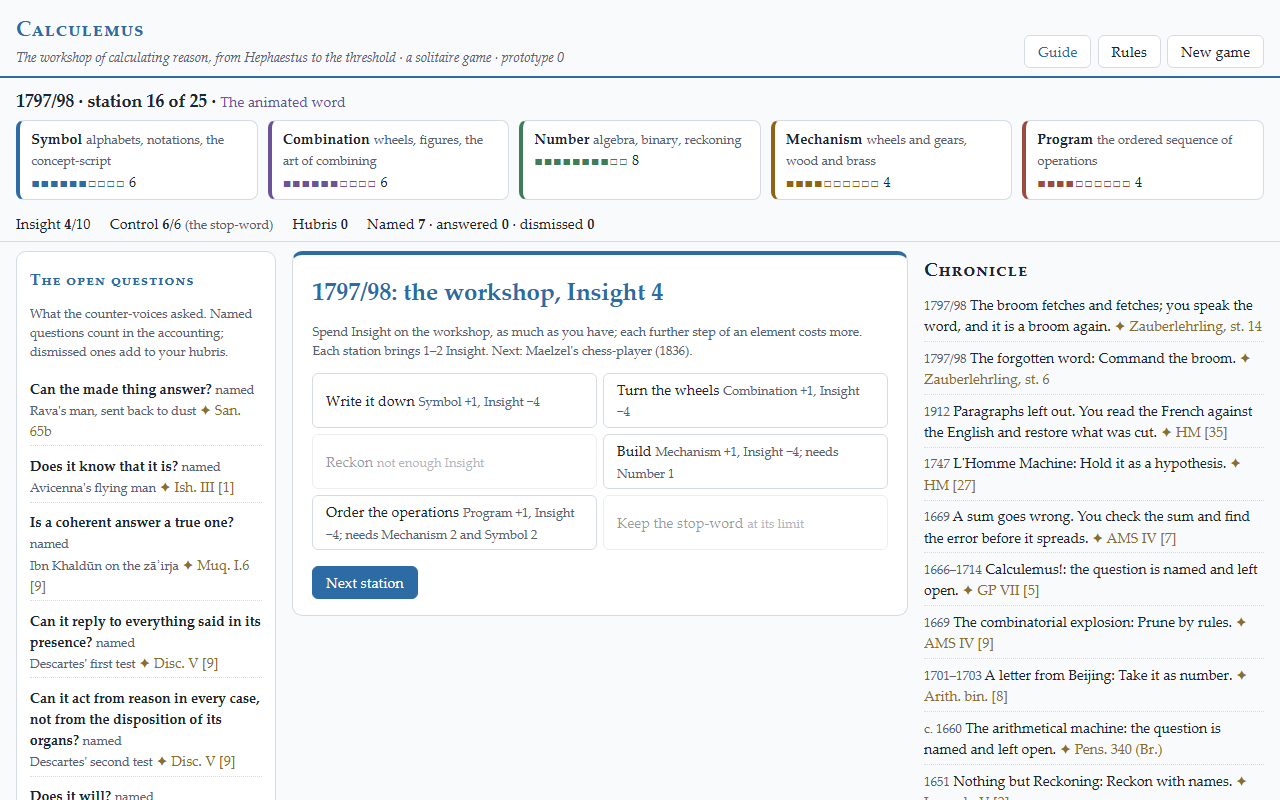
Five elements. Symbol, Combination, Number, Mechanism and Program. The logical and machine stations raise them; between the stations you spend your Insight to raise them further, each step dearer than the last. If every element stands high enough at the threshold, the machine is complete on paper.
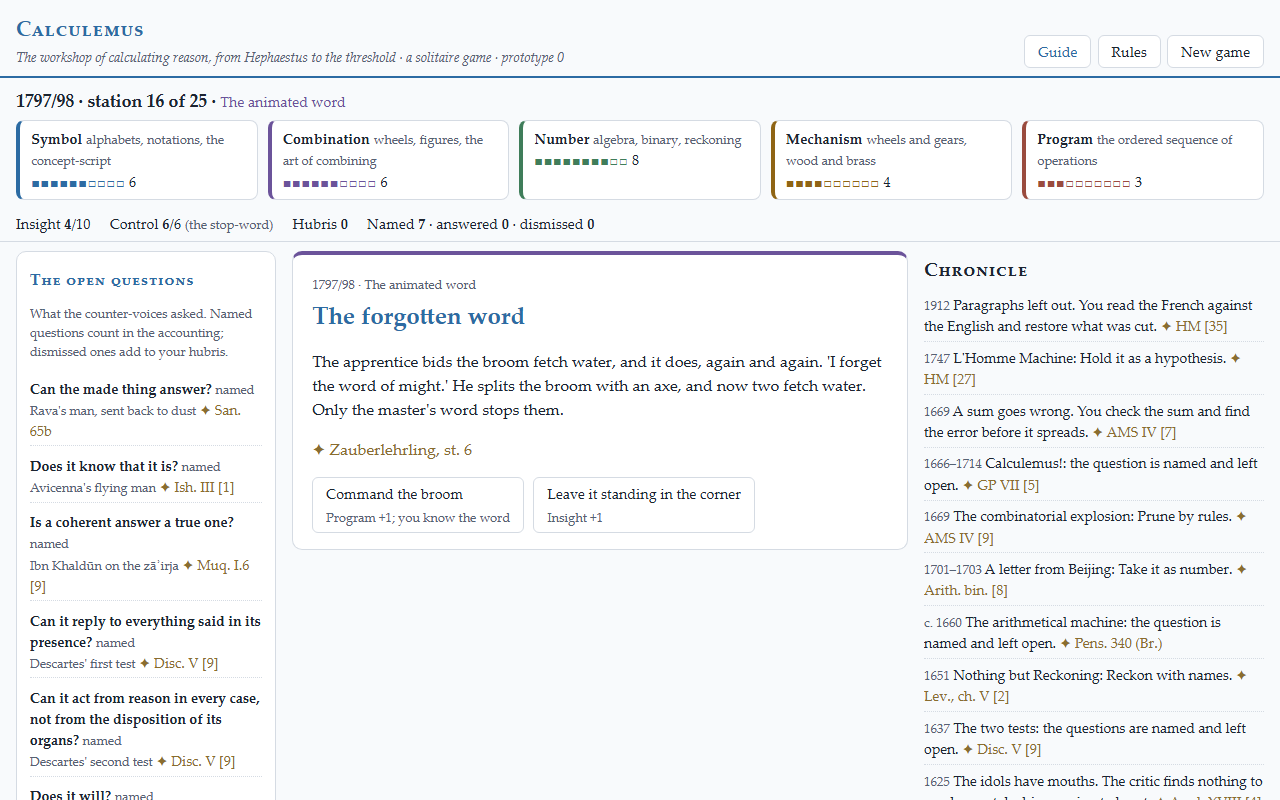
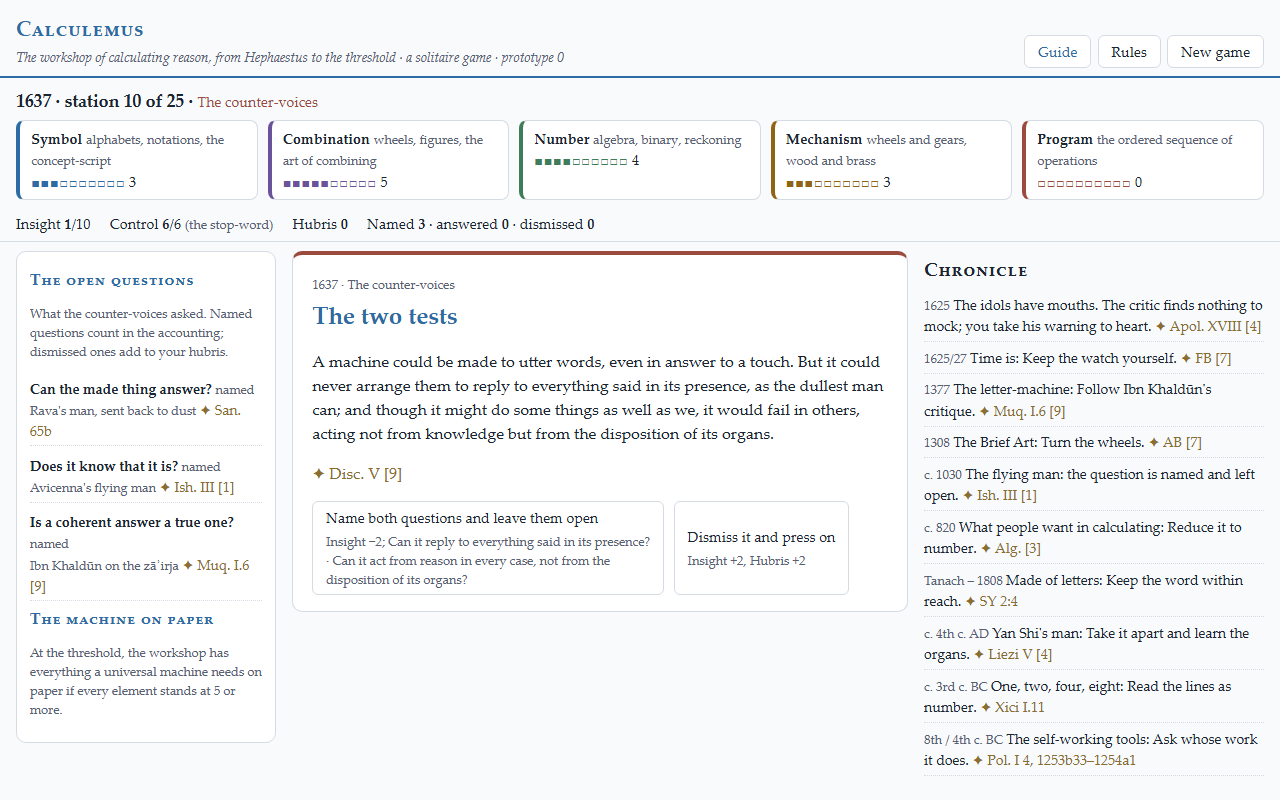
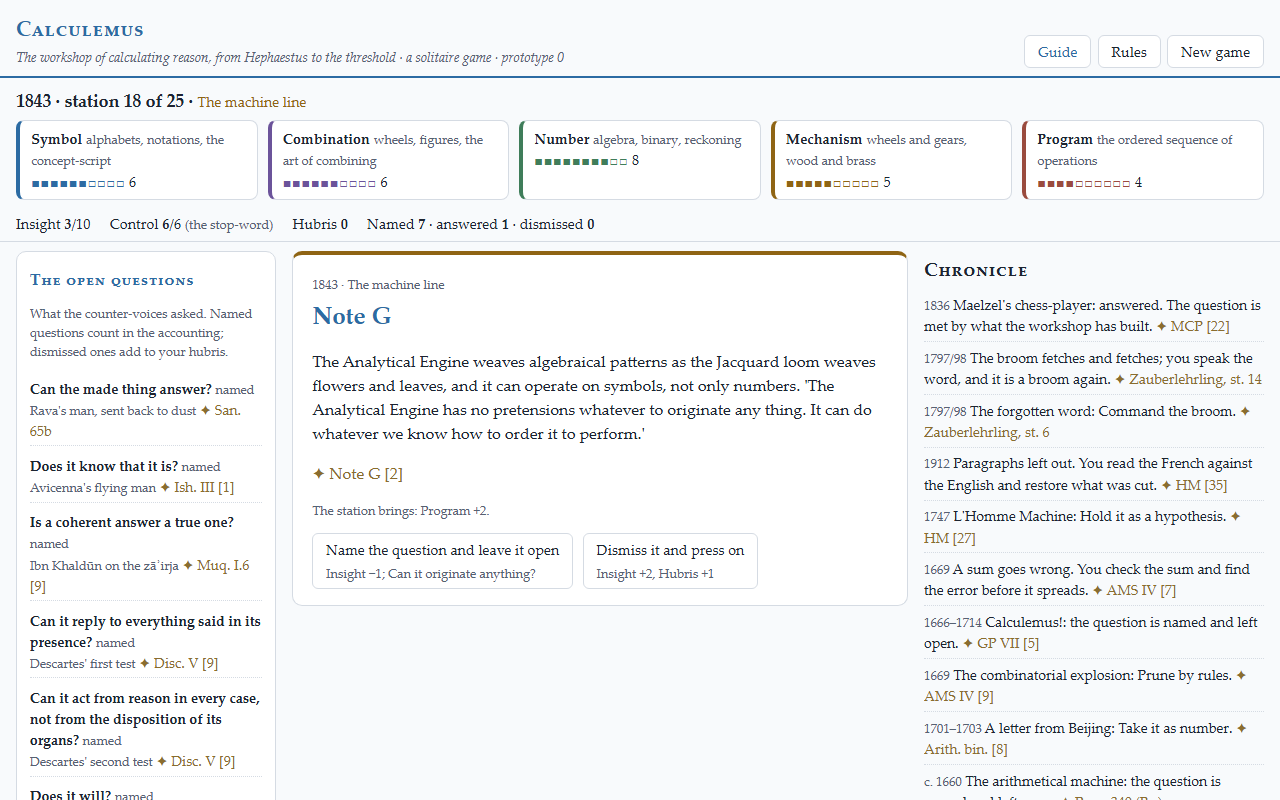
The counter-voices ask. Avicenna: does it know that it is? Descartes: can it reply to everything said in its presence? Pascal: does it will? Leibniz: where is perception in the mill? Lovelace: can it originate anything? Name a question and leave it open, at a cost, or dismiss it and press on, and watch your hubris grow. One question, Poe's, can be answered, if you have built enough by 1836.
The stories warn. The golem with the word on its forehead, the sorcerer's apprentice who forgot the word of might, the brazen head that spoke while the servant was singing, the robots who rise. Keep the stop-word, or the broom floods the hall.
The footnotes open. Every card cites its passage, and one click opens it in the public-domain documentary apparatus Calculemus: Philosophical predecessors of AI, in the original language, Greek, Latin, Arabic, Hebrew, Chinese, French, German or Czech, with an English translation.
- Twenty-five stations, one for each text, about twenty-five minutes
- Five elements to build, Insight as your only budget
- Eleven questions of the counter-voices to name, dismiss or answer
- Seven incidents from the sources: a letter from Beijing, a wrong sum, paragraphs left out of a translation
- A strategy guide in the game, every piece of advice tested against 400 bot games
- Autosave in your browser; nothing is sent anywhere
- Meant to be accessible
A teaching game, not a simulation. The accounting asks what became calculable, what stayed open and what the stories warned, and says where these do not belong in one sum.
Credits. Design and development: Pantaleon Fassbender, built with the help of Claude (Anthropic) for code and card texts. Cover: the prima figura of Ramon Llull's Ars brevis, Strasbourg 1617, public domain. Sources: public-domain editions and translations named in the documentary apparatus. Code MIT, content CC BY 4.0. By the maker of Vitalienbrüder, Řádné poslušenství, En nom Dieu, Nec in communi, The Turned Standard, La más alta ocasión and Ad maiorem.
Development log
- Eleven questions older than the machine4 days ago
Leave a comment
Log in with itch.io to leave a comment.