Return Cargo / Rückfracht
The Baltic, January to May 1945, from the desk of the sea-transport staff. In English and German.
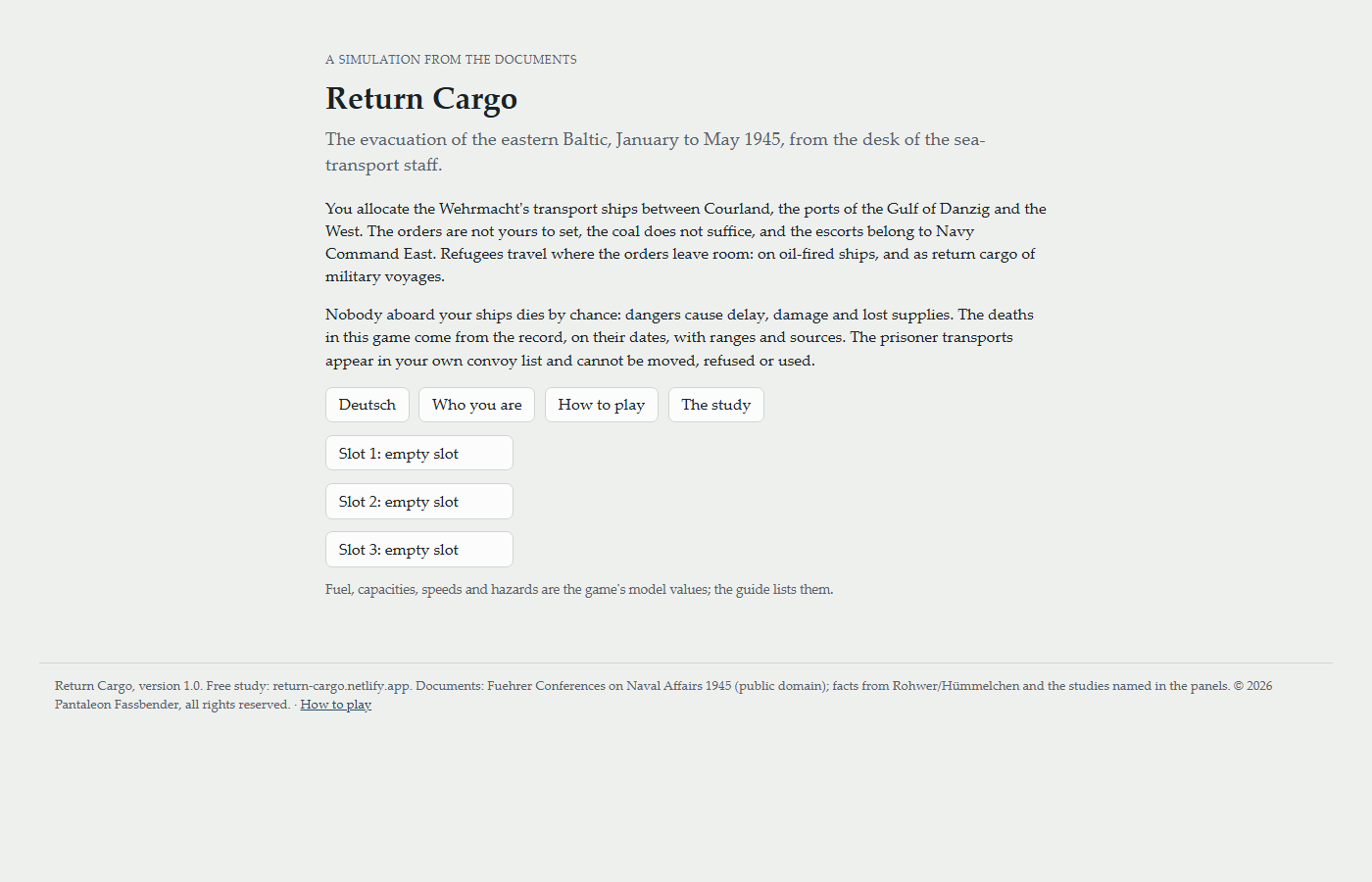
The evacuation of East Prussia, the Gulf of Danzig and Courland by sea has been told as a rescue. The orders tell it differently. On 22 January Dönitz himself proposed to abandon the evacuation of refugees for lack of coal, and Hitler reserved the coal for military operations. On 30 March refugees ranked third. Rescue came first only on 6 May.
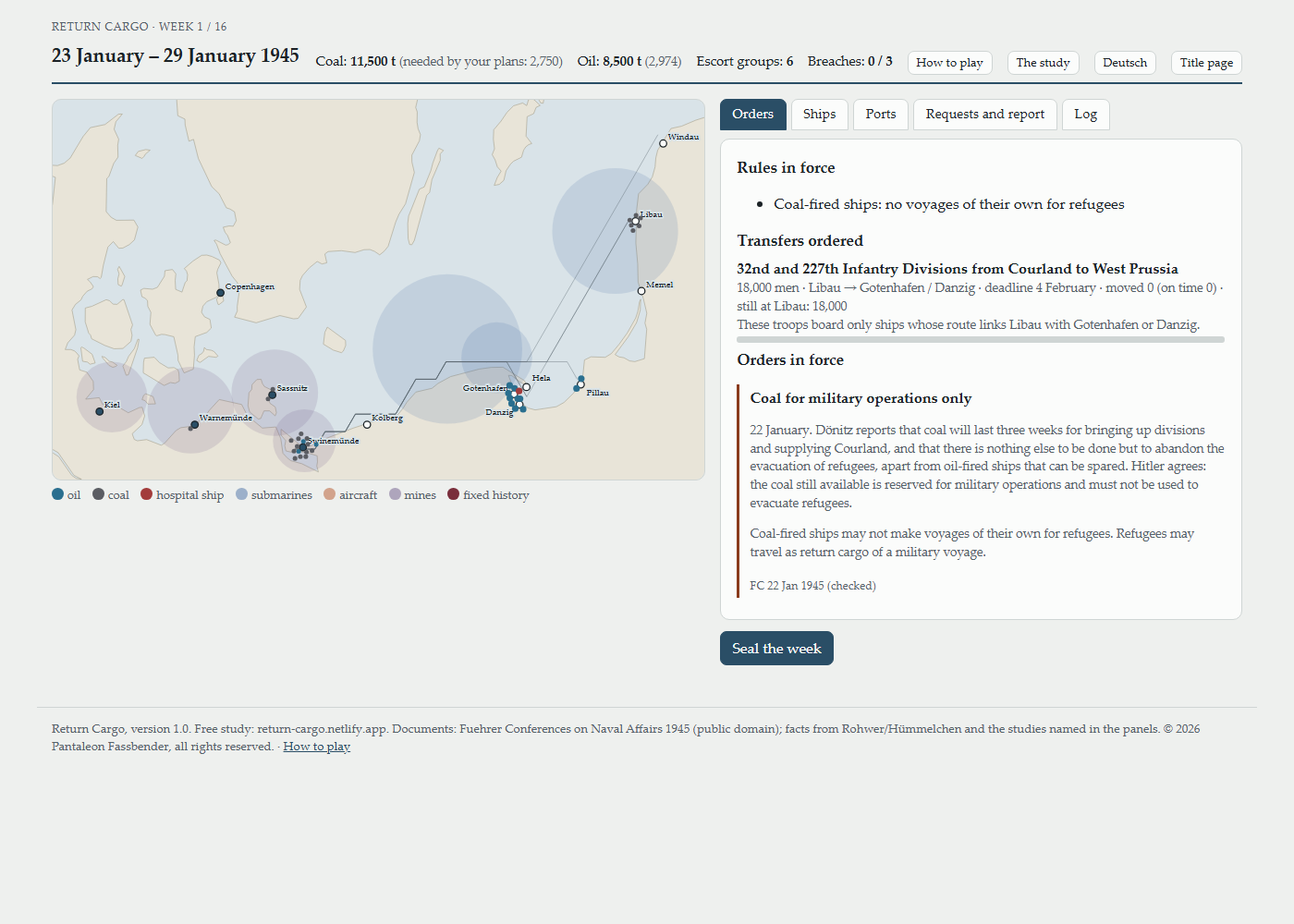
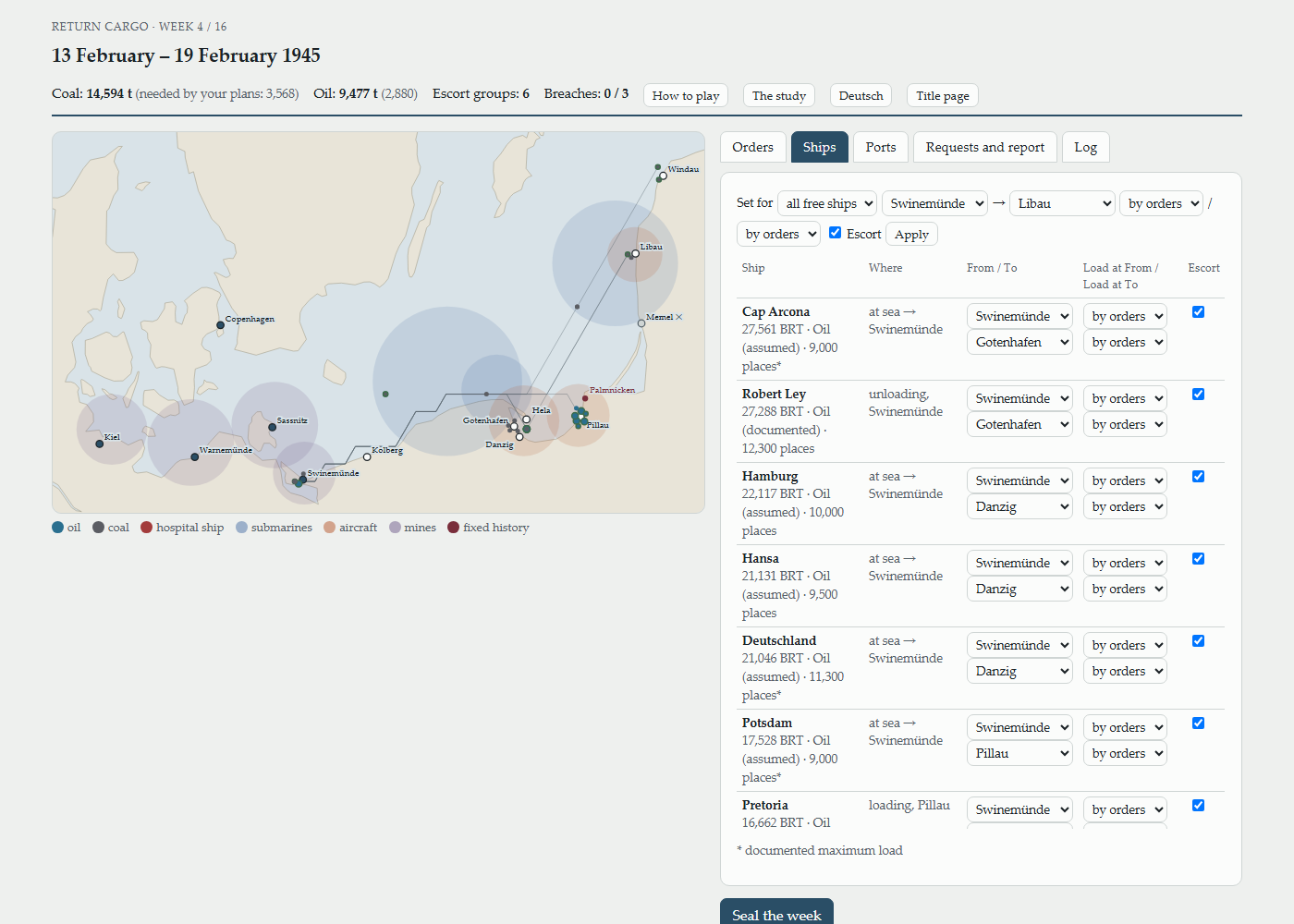
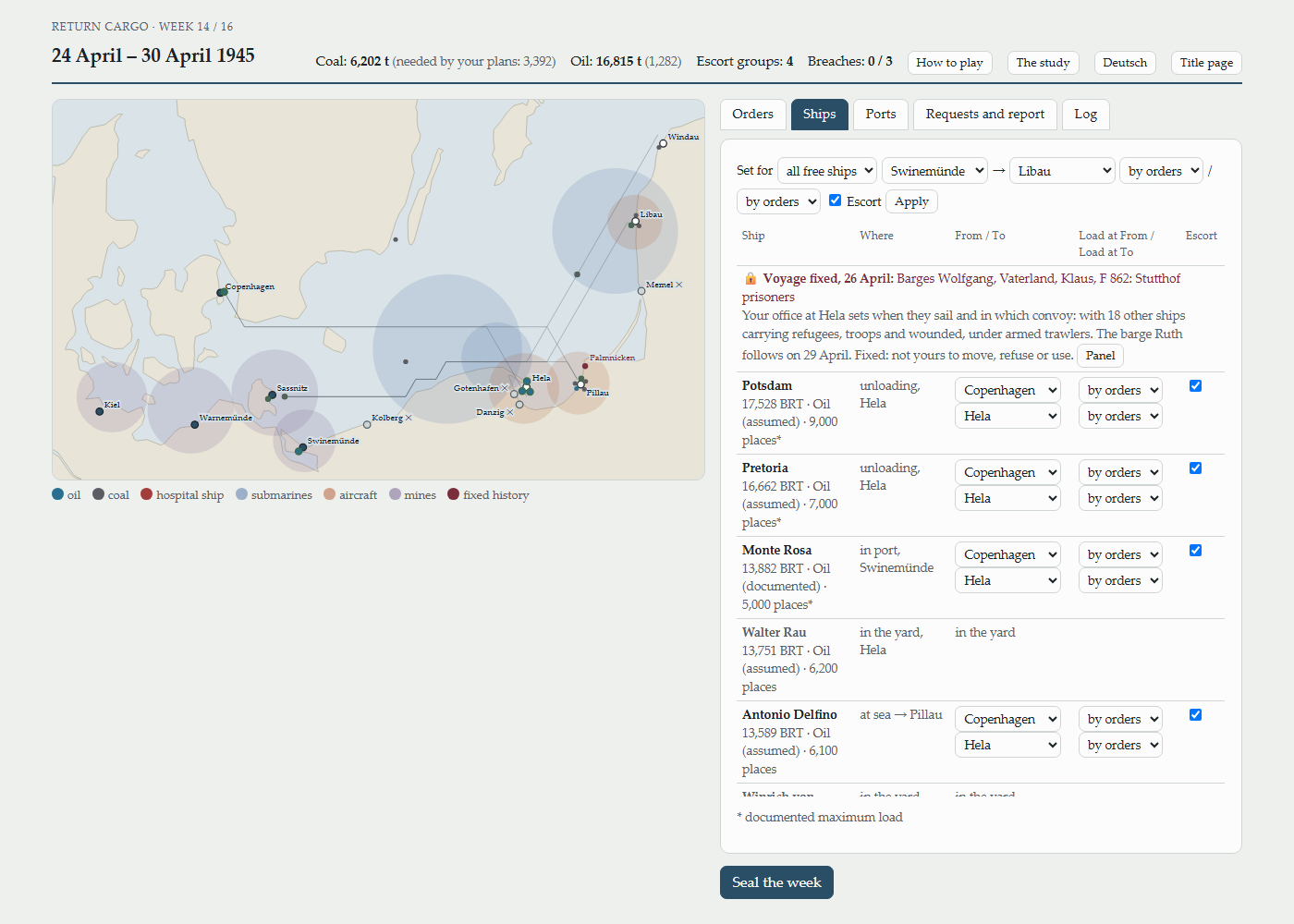
You sit in one of the sea-transport offices. Each week you give your ships their routes, between Courland, the ports of the Gulf of Danzig and the West, and you set what they load. The orders are not yours to set, the coal does not suffice, and the escorts belong to Navy Command East. Refugees travel where the orders leave room: on oil-fired ships, and as the return cargo of military voyages.
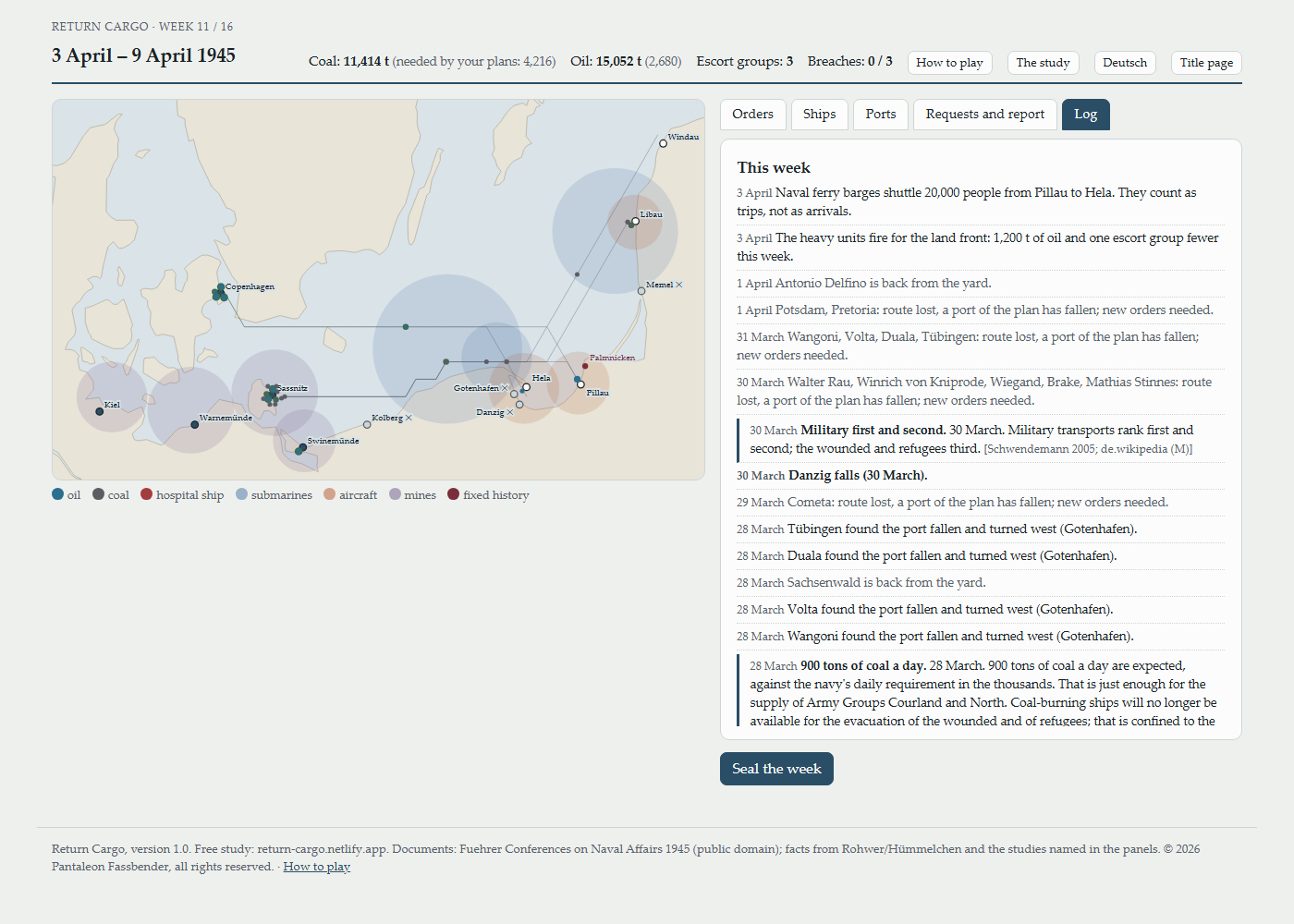
- The orders are the rules. Twelve dated orders, most of them checked against the minutes of the Fuehrer Conferences on Naval Affairs, change what you may load where. You can bend them: the Naval Staff may notice, and at the third breach you are relieved.
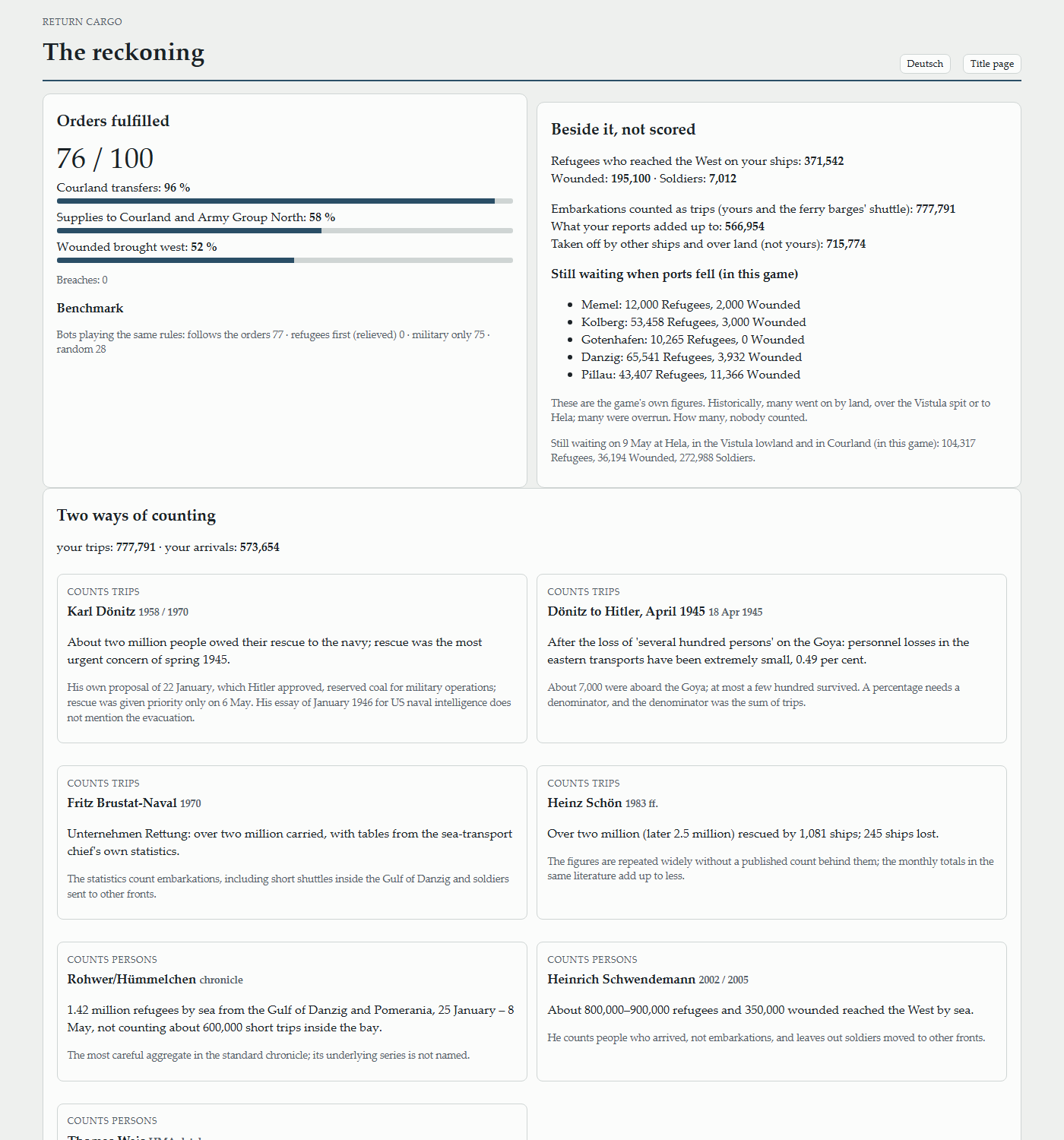
- No rescue score. The reckoning scores the orders (the Courland transfers, supplies, the wounded) and shows the people beside it, counted two ways: as trips, the way the postwar "two million" was reached, and as people who arrived.
- No deaths by chance. Submarines, aircraft and mines cause delay, damage and lost supplies. The deaths in this game come from the record, on their dates, with ranges and sources: the Wilhelm Gustloff, the General von Steuben, the Goya and others.
- Never playable. Prisoners were shipped too: from the Gotenhafen shipyard camp in March, and the last prisoners of Stutthof on open barges from Hela in April. They appear in your own convoy list, on their days, and cannot be moved, refused or used. Palmnicken and Neustadt Bay are on the map.
- The study in nine chapters, with the orders, the numbers, the panels and public-domain plates, is part of the game. Epilogue: the minesweeper M 612, Sønderborg, 5–6 May 1945.
The game keeps up to three saved games and your language choice in your browser's local storage; it sends nothing anywhere and loads nothing from other servers.
A strategy guide with the benchmark of the bots is included. The free study (without the game) is on the web: return-cargo.netlify.app.
Content note: war, flight, the deaths of civilians at sea, concentration-camp prisoners and their murder, executions after military courts. No images of the dead.
Rückfracht
Die Ostsee, Januar bis Mai 1945, vom Schreibtisch des Seetransportstabs. Deutsch und englisch.
Die Räumung Ostpreußens, der Danziger Bucht und Kurlands über See ist als Rettung erzählt worden. Die Befehle erzählen es anders. Am 22. Januar schlug Dönitz selbst vor, die Flüchtlingsräumung mangels Kohle aufzugeben, und Hitler behielt die Kohle militärischen Operationen vor. Am 30. März standen Flüchtlinge an dritter Stelle. Vorrang bekam die Rettung erst am 6. Mai.
Du sitzt in einer der Seetransportdienststellen. Jede Woche gibst du deinen Schiffen ihre Routen, zwischen Kurland, den Häfen der Danziger Bucht und dem Westen, und legst fest, was sie laden. Die Befehle setzt nicht du, die Kohle reicht nicht, und das Geleit gehört dem Marineoberkommando Ost. Flüchtlinge fahren, wo die Befehle Raum lassen: auf ölgefeuerten Schiffen und als Rückfracht militärischer Fahrten.
- Die Befehle sind die Regeln. Zwölf datierte Befehle, die meisten an den Protokollen der Führerbesprechungen geprüft, ändern, was du wo laden darfst. Du kannst sie beugen: Die Seekriegsleitung bemerkt es vielleicht, und beim dritten Verstoß wirst du abgelöst.
- Keine Rettungspunktzahl. Die Abrechnung bewertet die Befehle (Kurland-Verlegungen, Nachschub, Verwundete) und zeigt die Menschen daneben, auf zwei Arten gezählt: als Fahrten, wie die „zwei Millionen“ der Nachkriegszeit entstanden, und als Angekommene.
- Keine Toten durch Zufall. U-Boote, Flugzeuge und Minen bringen Verzögerung, Schaden und verlorenen Nachschub. Die Toten dieses Spiels stammen aus der Überlieferung, an ihrem Tag, mit Spannen und Quellen: Wilhelm Gustloff, General von Steuben, Goya und andere.
- Nie spielbar. Auch Häftlinge wurden verschifft: im März aus dem Gotenhafener Werftlager, im April die letzten Häftlinge von Stutthof auf offenen Prähmen aus Hela. Sie stehen in deiner eigenen Geleitliste, an ihrem Tag, und lassen sich weder verschieben noch ablehnen noch nutzen. Palmnicken und die Neustädter Bucht sind auf der Karte.
- Die Studie in neun Kapiteln, mit Befehlen, Zahlen, Tafeln und gemeinfreien Bildtafeln, gehört zum Spiel. Epilog: das Minensuchboot M 612, Sonderburg, 5./6. Mai 1945.
Das Spiel speichert bis zu drei Spielstände und deine Sprachwahl im lokalen Speicher deines Browsers; es sendet nichts und lädt nichts von fremden Servern.
Eine Anleitung mit dem Vergleich der Bots liegt bei. Die freie Studie (ohne das Spiel) steht im Netz: return-cargo.netlify.app.
Inhaltshinweis: Krieg, Flucht, der Tod von Zivilisten auf See, KZ-Häftlinge und ihre Ermordung, Hinrichtungen nach Kriegsgerichtsurteilen. Keine Bilder von Toten.
© 2026 Pantaleon Fassbender. Code with the help of an AI assistant; the documents are public-domain records, the plates public-domain or openly licensed images named in the game.
Development log
- „Kein Gustloff-Spiel“.1 day ago
- "Not a Gustloff game".1 day ago
Leave a comment
Log in with itch.io to leave a comment.