Relief and Navigation
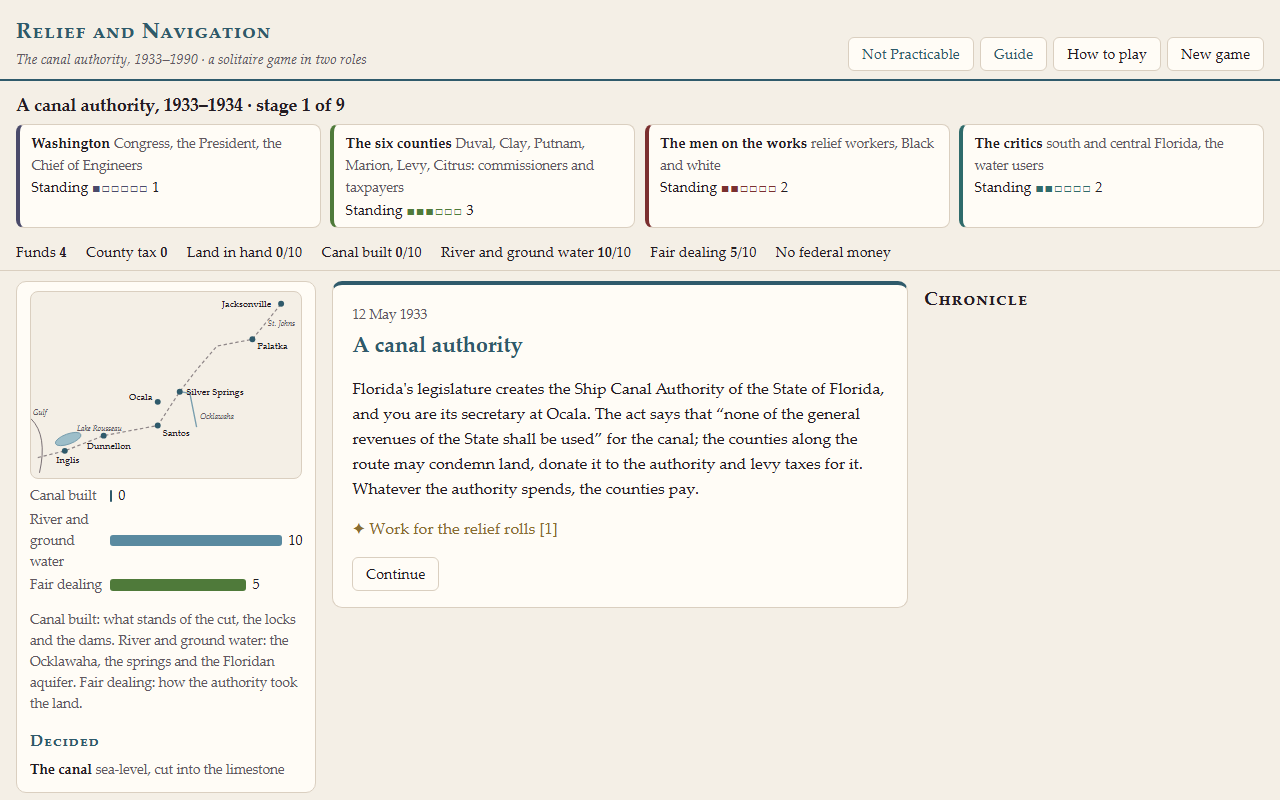
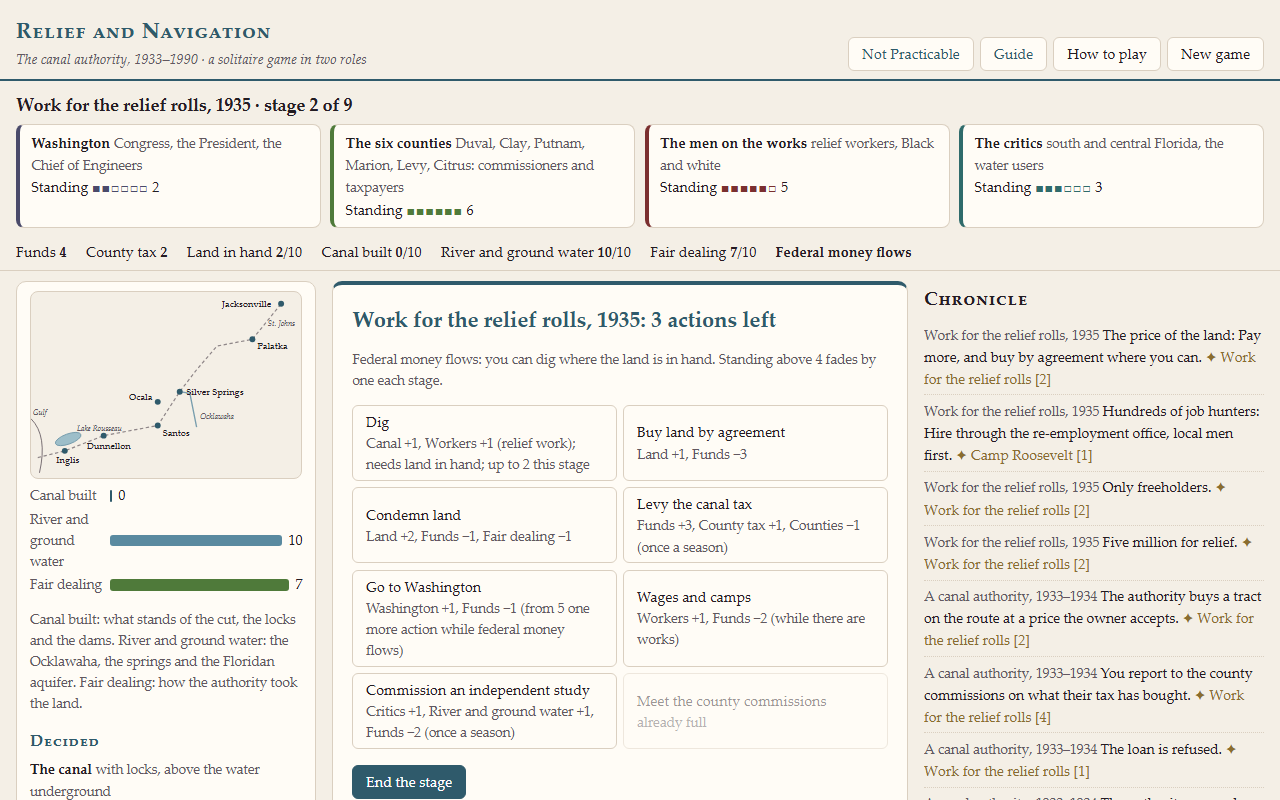
Florida, 1933. The legislature creates a Ship Canal Authority, and you are its secretary at Ocala. The State will not pay a cent; the counties along the route will, and the men on the relief rolls will dig.
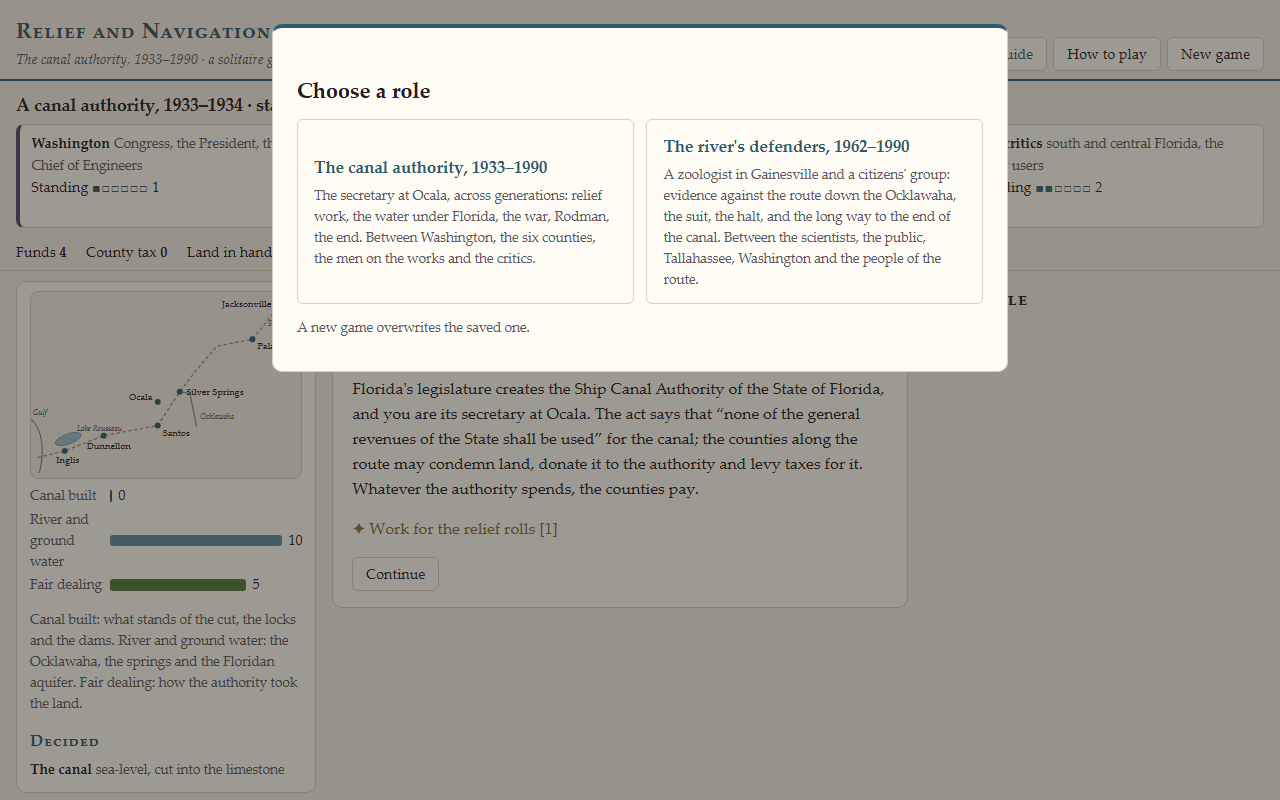
Relief and Navigation is a documentary solitaire game about the canal across Florida, begun twice, stopped twice and ended by law in 1990. Its title comes from the Chief of Engineers, who recommended the canal in 1937 “as a combination of unemployment relief and of navigation improvement”, against his own board. You play it in two roles, both in one purchase.
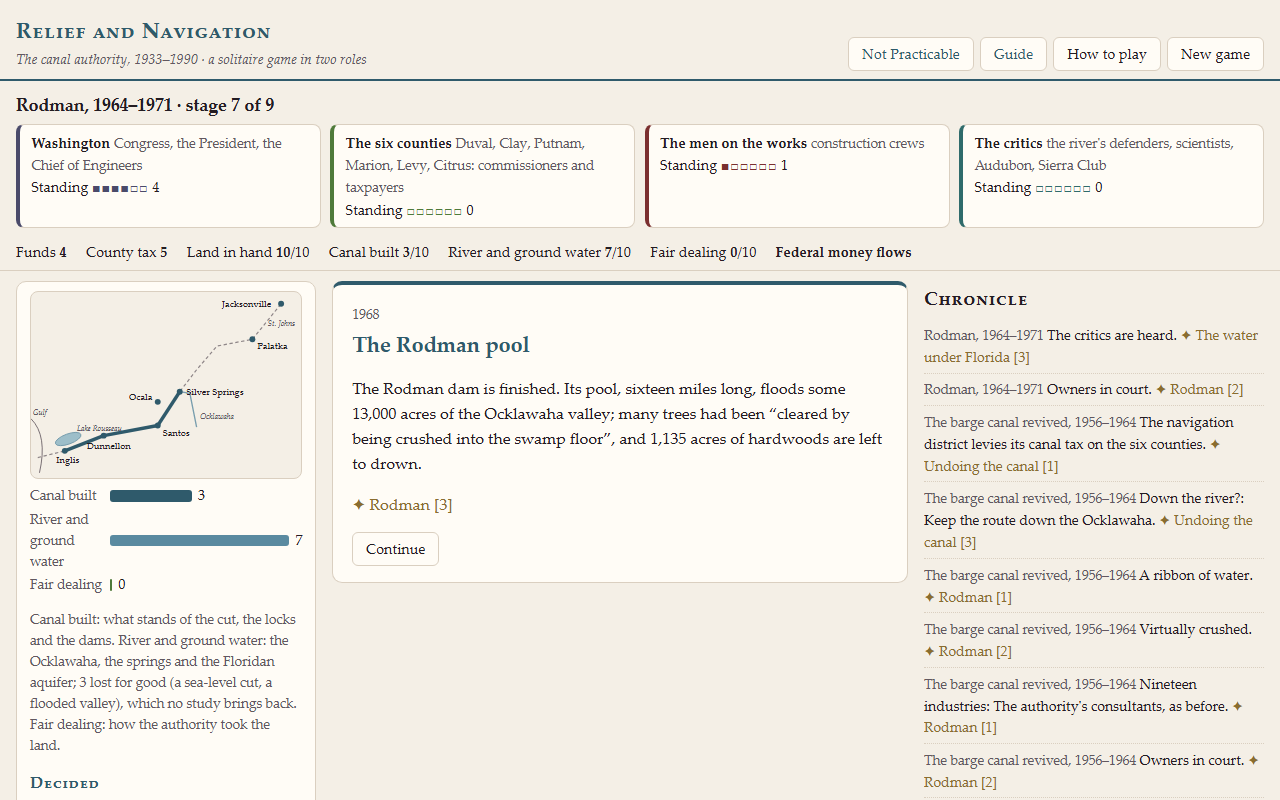
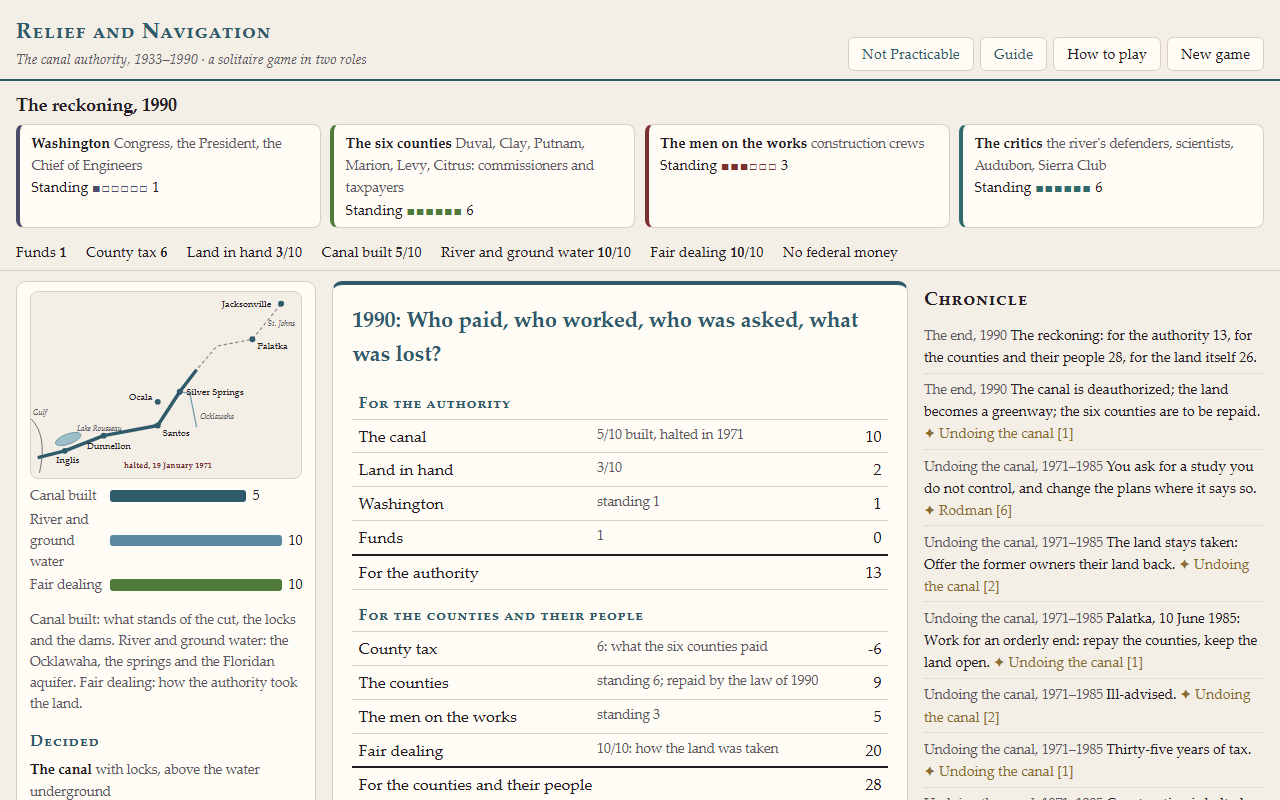
The canal authority, 1933–1990. Across generations of secretaries, you ask Washington for money, buy or condemn the land, levy the canal tax on six counties, hire the relief workers for Camp Roosevelt, answer the Geological Survey's warning about the water under Florida, and choose the route through the Ocklawaha valley, or away from it. What Congress, the Presidents and the courts decided happens as it happened: the Senate refuses the ship canal in 1936 and 1939, Congress authorizes a barge canal with locks in 1942, the President breaks ground at Palatka in 1964 and halts the works in 1971.
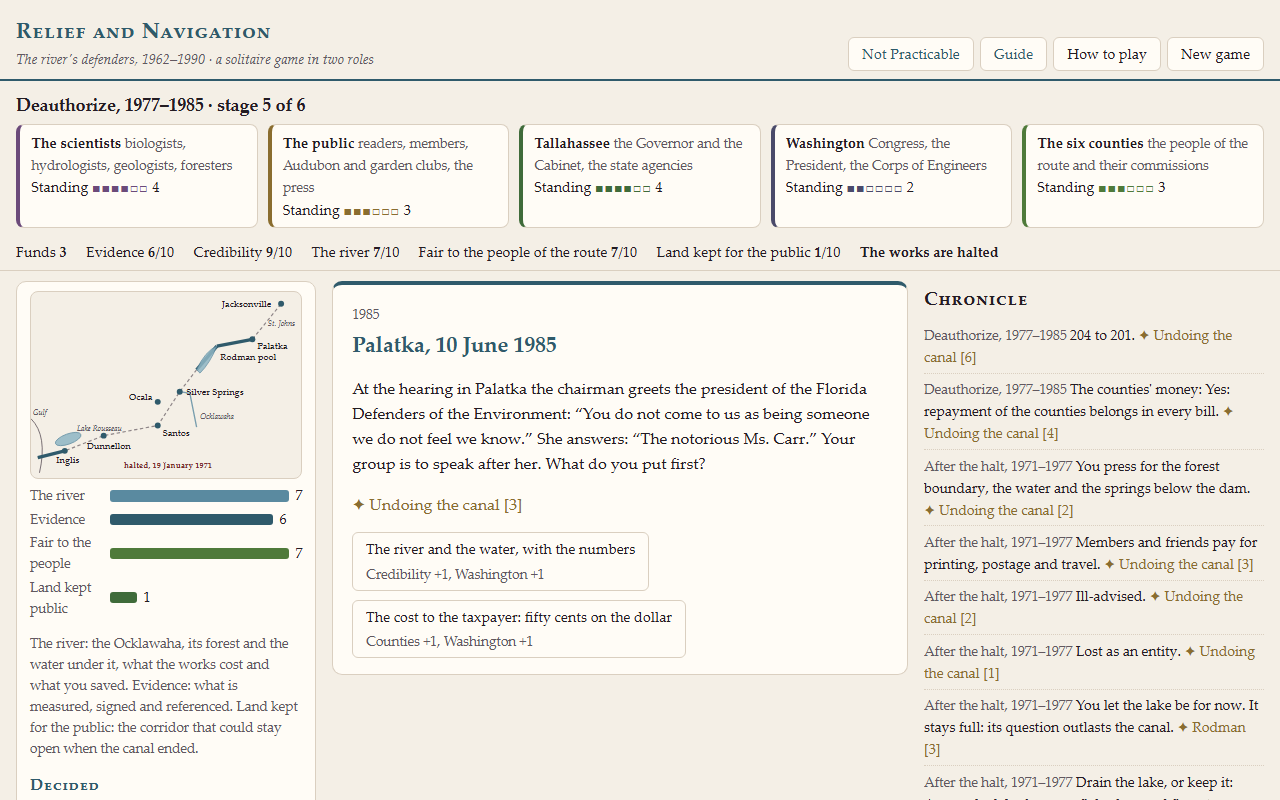
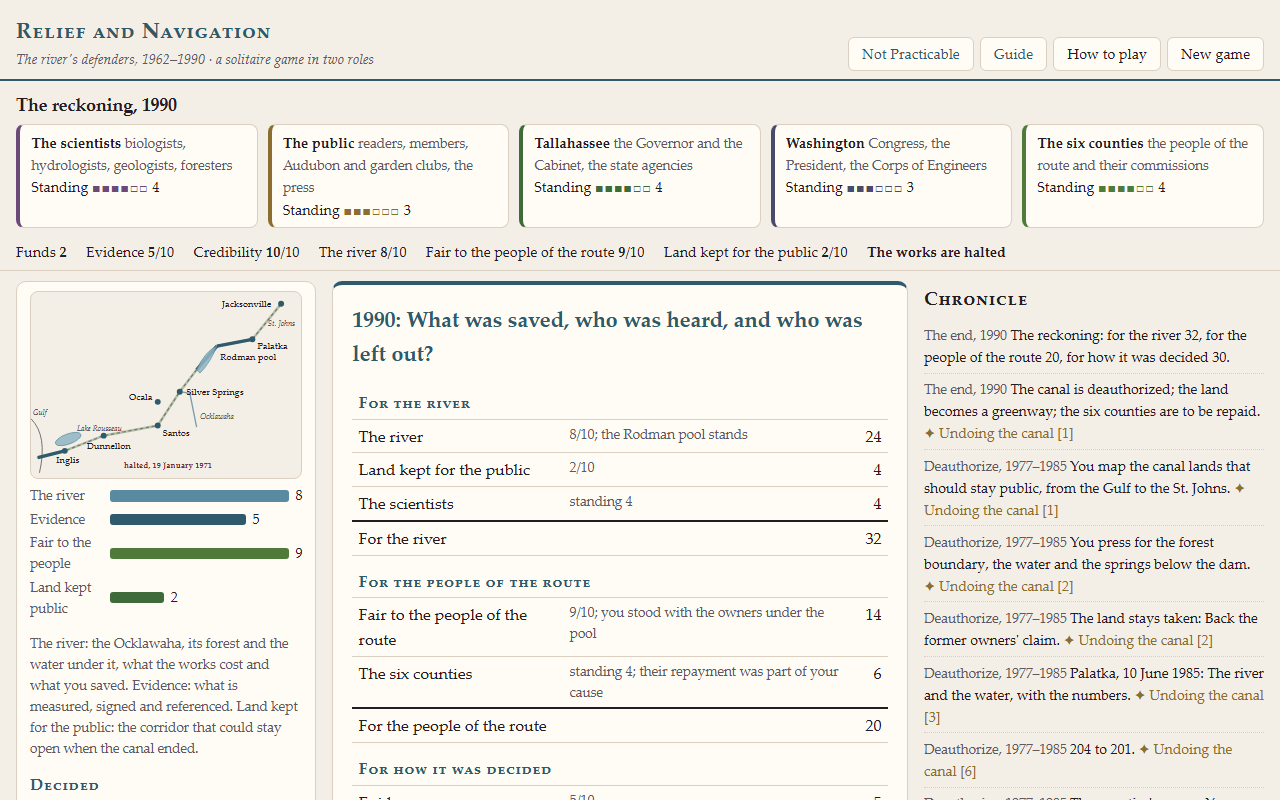
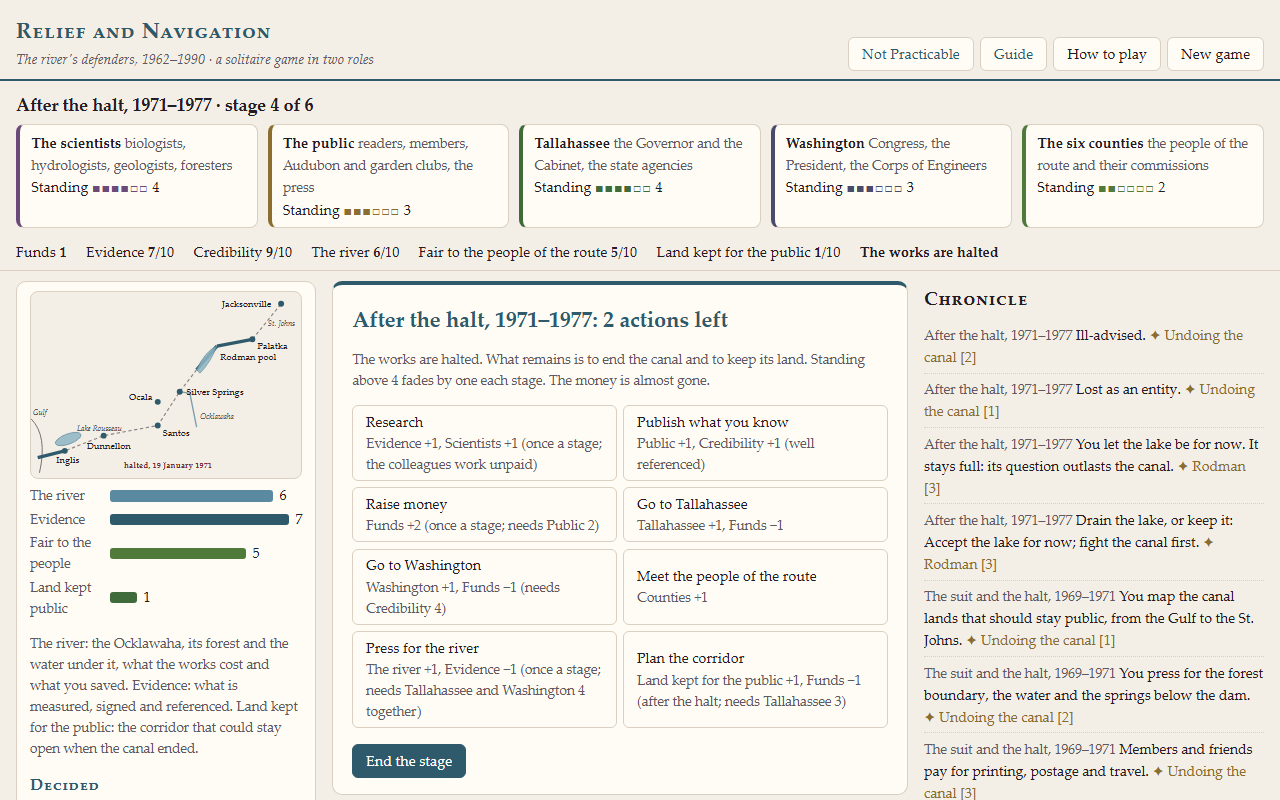
The river's defenders, 1962–1990. A zoologist in Gainesville and a citizens' group, a composite figure, not a person of record. Until 1966, as Marjorie Carr told Congress in 1985, “no one in government would listen to us at all”. You gather evidence, publish, raise money, win Tallahassee and then Washington, join the suit of 1969, and decide what is owed to the people along the route: the owners under the Rodman pool, the counties who paid the canal tax, the former owners who wanted their land back.
Who paid, who worked, who was asked, and what was lost? The reckoning of 1990 asks three questions with equal weight. For the authority: the canal, and also the counties and their people, and the land itself, its river, springs and ground water. For the defenders: the river, the people of the route, and how it was decided. A canal pushed through against everyone does not win, and neither does a river saved by forgetting the people along it.
Exclusion and death are never moves. The bond vote of 1935, open only to property owners who had paid their poll tax, and the death of John Matthews, the only canal worker of those months whom the sources name, are chronicle cards: the game pauses for them, and they stand in the reckoning as lines without points.
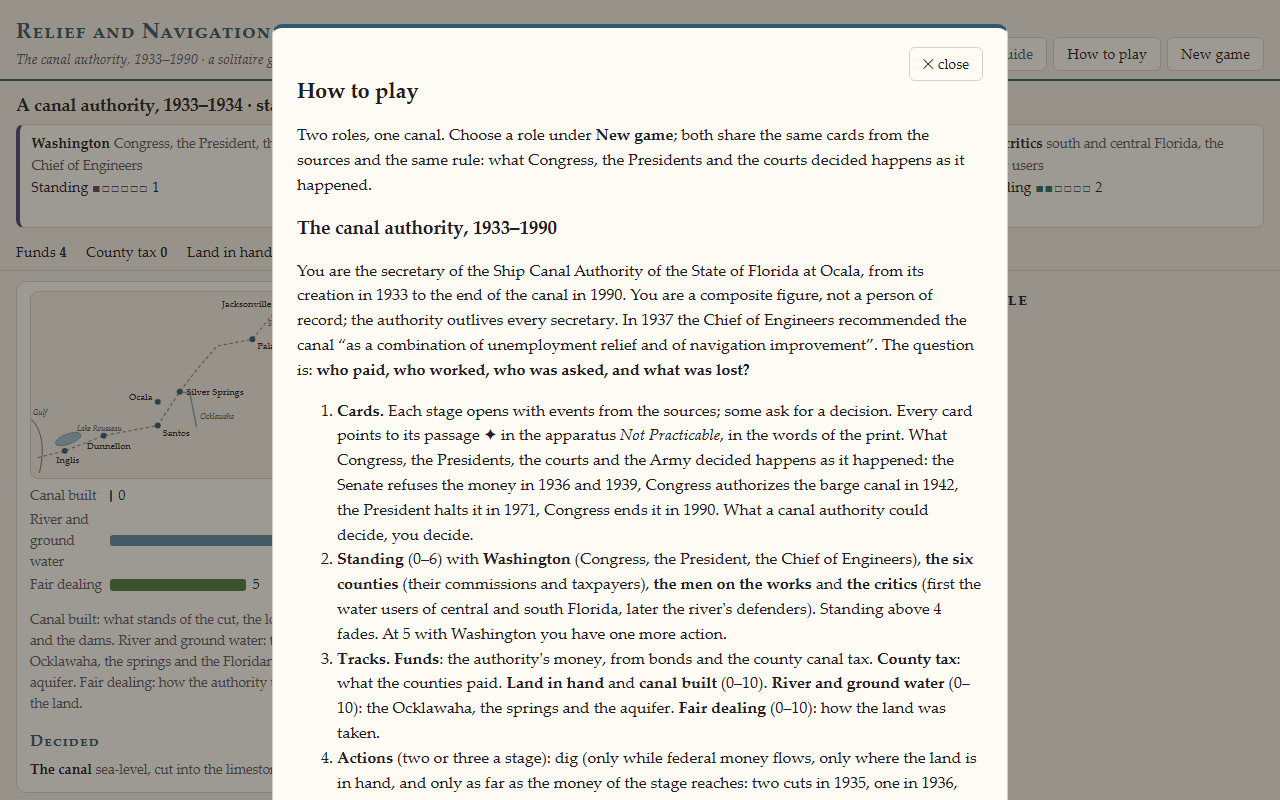
Every card links to its source. Each card opens its passage in the free documentary apparatus Not Practicable (doi:10.5281/zenodo.23226295): congressional documents, the Army engineers' reports, Geological Survey papers, court decisions, Florida newspapers and the hearing of 1985, in the words of the print. Where you can take a course that history did not, the card says so.
- Two roles: the canal authority (nine stages, 1933–1990) and the river's defenders (six stages, 1962–1990)
- A strategy guide in the game, every lesson checked against 400 bot games; compare your result with 300 bot games at the end
- Autosave in your browser; nothing is sent anywhere
- English; mouse; plays in the browser
Cover: the canal works of 1935–36 (Documentary History of the Florida Canal, Senate Document 275, 1936) and the steamer Osceola on the Ocklawaha (photograph by George Barker, 1886, Library of Congress); both public domain.
Development log
- A canal that scores 18.8 hours ago
Leave a comment
Log in with itch.io to leave a comment.